Posts

PowerCLI: Configuring an All-Flash vSAN
Image
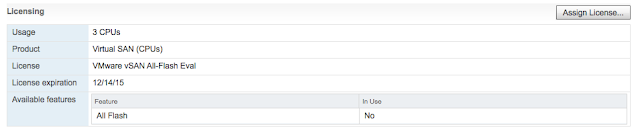
From my understanding all-flash vSAN works like this: Caching Tier is 100% Writes. (Write Buffer) Capacity Tier is Mixed-Use With this in mind, I ordered Dell R730's w/ two types of drives.  Two high write endurance SSD's and Four Mixed Use SSD's. Short Story: Here is the script I created to 'tag' the mix-use drives as flash capacity: #Enable All Flash vSAN Intelligently Add-PSSnapIn -Name VMware.VimAutomation.Core -ErrorAction SilentlyContinue $TargetHosts = Get-VMHost $CacheDiskVendor = "TOSHIBA" $CacheDiskModel = "PX02SSF040" $CapacityDiskVendor = "TOSHIBA" $CapacityDiskModel = "PX02SMF040" Foreach ($VMhost in $TargetHosts) { $ESXCLI = $VMHost | Get-ESXCLI $Storage = $VMhost | Get-VMHostStorage Foreach ($SCSILUN in $Storage.ScsiLun) { If ($SCSILUN.Vendor -match $CapacityDiskVendor -and $SCSILUN.Model -match $CapacityDiskModel) { $ESXCLI.vsan.storage.tag....

PowerCLI: Configure/Enable Remote Syslog

[Updated ESXCLI call to v2 to reload syslog service] Been spoiled w/ Log Insight , so didn't realize what I needed to do to get logs forwarded to Splunk Cloud from ESXi hosts.  Here is the script I wrote up to do so: #Gets your list of hosts to configure for remote syslog. $VMHosts = Get-VMHost #$VMHosts = Get-Cluster MyCluster | Get-VMHost #Uncomment and comment line above if you want to target hosts in a cluster only. #The remote syslog destination(s). $SyslogValue = "tcp://192.168.123.5:514,udp://192.168.123.6:514" #If Replace is set to true, will simply overwrite whatever is populated currently. If False, then it will append. $Replace = $true #If ConfirmPreference is set to true, this script will ask you on every single host whether you want to make the change. Set to $False, if you just want it to do it. $ScriptConfirmPreference = $false ## Don't modify from here ## $AdvancedSettings= $VMHosts | Get-AdvancedSetting| where {$_.name -match "syslog.glo...

SWAG: VMWorld 2015 - MGT4783 - Introduction to Monitoring the Public Cloud with vRealize Operations Manager

Image
Slots still open for our session .  Join us as we walk you through installing, configuring, and utilizing the AWS management pack for vRealize Operations .  During our Q&A we'll be giving away some swag bags from FlexDrive (Stickers, T-Shirt, keychain, and Car Vent cell phone holder).  We'll also have some Cox Automotive power bricks to giveaway to a lucky few.  Maybe some other free stuff too. Swag Bag Looking forward to a great session and want to make sure you technical folks leave w/ some useful reference material and general info.  Swag is always good too. \(^o^)/ Speakers: K. Chris Nakagaki - Technical Lead Engineer Sonya Ryherd - Sr. Systems Engineer

vROPs: Take Cluster Offline: Status: Removing Slice

Image
Applies to vROPs running in NON-HA mode, below was thanks to help from VMware support.  They have an internal KB on this so it should eventually be published or more likely fixed in the future.  Mostly for my own notes, but interesting for those tinkerers out there. Case: Attempting to remove remote collector node from vROPs to replace w/ larger remote collector.  Correct way would have been to move 'instances' to other collector or data nodes before putting collector node offline.  Instead, I just removed the collector node from the admin console.  That's when it got stuck in this state. It's supposed to move the 'instances' to other collectors, but that didn't seem to work and it got stuck in a state of taking the cluster offline.  So to remove the remote collector and get back to a stable state, VMware support walked me through below. Resolution to Case: DO NOT ATTEMPT BELOW STEPS UNLESS YOUR CASE MATCHES ABOVE EXACTLY OR YOU REALLY KNOW WHA...

Did you know? Running ESXi on Macs has licensing caveats...

Image
Did you know that according to Apple's OS X EULA, you are only allowed to run 2 OS X VM instances per physical device? So what does that mean for running ESXi on a Mac Pro?  You can only run, legally , 2 OS X VM's on it. http://images.apple.com/legal/sla/docs/OSX1010.pdf How's them apples?  Kinda sucks, wondering what other people have done to get around this?  Mac Mini value was much better w/ vSAN when it had two internal disks (for the server version). Really the only option is to talk to your Apple rep and see how you can license more.

Opinion: Nutanix Acropolis and VMware

Image
I was lucky enough to attend the inaugural Nutanix .NEXT conference in Miami the last 3 days.  I learned a lot and met many new faces.  Here is the bottom line: Nutanix has released their flavor of the KVM hypervisor dubbed " Acropolis ". So what does that mean for you VMware shops? Right now, possibly lower or complete removal of hypervisor licensing costs.  However, VMware is a leader for a reason, so you will likely need to augment by using something like VMTurbo to manage and give you smarter DRS like capability plus more.  I'll need to read-up on Acropolis feature sets, but the fair comparisons would likely be between the base vSphere ESXi editions (including vCenter)  vs Acropolis / Prism  and/or the vCloud Suite vs. Acropolis / Prism / VMTurbo combo.  It's going to come down to features and price. I'm thinking personally that it "MIGHT" be cheaper to go an Acropolis / Prism / VMTurbo route strictly from a licensing perspecti...

vRealize Operations (aka vROps) formerly vCenter Operations (aka vCOPs) Dictionary

Image
Found this on a community board  and well, thought it might be useful to repost.  Also looking to add to this as time permits. Term Definition Ascendant Any object higher in the "tree", includes parent (and grandparent, great-grandparent, etc) Parent Object directly above selected object (VM's parent is a host, for example.  Host parent is cluster, etc) Child Object(s) directly below selected object in the "tree" (host child(ren) is any VM on host) Descendant Any object lower in the "tree", include child, grandchild, great-grandchild etc The above information is useful when creating group objects and what not in vROps.